
Introduction
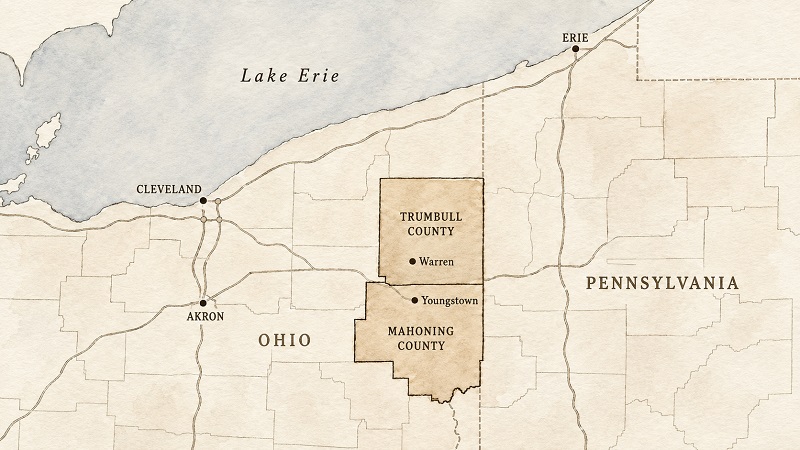
The Mahoning Valley is not one place. It is a collection of cities, townships and small communities spread across Mahoning and Trumbull counties, each with its own character, history and identity. Some grew up around the steel mills. Some developed as residential retreats for people who worked in the mills but wanted space and quiet. Some are old enough to predate the industrial era entirely. Understanding the valley means understanding its parts, because residents here tend to identify strongly with their specific community rather than the region as a whole.
What follows is a guide to the main communities of the Mahoning Valley — where they are, what shaped them, and what they are today.
Youngstown
Youngstown is the urban core of the valley and the city that put the region on the map. Platted in 1797 along the Mahoning River, it grew slowly at first and then rapidly once the steel industry took hold in the late 19th century. At its peak in the mid-20th century, Youngstown had a population of roughly 170,000 people and was one of the most productive industrial cities in the United States.
The steel collapse of the late 1970s and 1980s hit Youngstown harder than almost any other American city. Population today is around 60,000, a fraction of its former size, and the physical evidence of that decline is still visible in vacant lots, empty buildings and neighborhoods that never recovered. The city has been the subject of significant academic study and national journalism about deindustrialization and urban shrinkage.
What Youngstown also has is a resilient core that surprises first-time visitors. Downtown has seen genuine reinvestment since the 2000s. The Youngstown Business Incubator built a national reputation for supporting technology startups. The arts scene is active and punches well above its weight for a city this size. Youngstown State University anchors the north side of downtown and brings thousands of students into the urban fabric. The city's bones — the street grid, the architecture, the scale — are those of a real American city, and people who spend time here tend to leave with more respect for it than they arrived with.
Warren
Warren is the county seat of Trumbull County and the second largest city in the valley. It sits about fifteen miles north of Youngstown along the Mahoning River and has its own distinct identity, separate enough from Youngstown that residents will make sure you understand the distinction.
Warren was actually settled before Youngstown and served as an important administrative center in the early years of the Western Reserve. It developed its own industrial base over the 19th and 20th centuries, with manufacturing in steel, packaged goods and automotive components. Like Youngstown, it suffered significantly from deindustrialization, though the scale of loss was somewhat smaller.
Today Warren has a stable downtown with some attractive historic architecture, a community that takes its local institutions seriously, and a location that puts it within easy reach of both Youngstown to the south and the Cleveland metro area to the west. The Trumbull County seat brings a layer of government employment that has helped stabilize the local economy.
Boardman Township
Boardman is not a city — it is an unincorporated township in Mahoning County — but it functions as one of the most commercially active communities in the entire valley. Located directly south of Youngstown, Boardman developed through the second half of the 20th century as the suburban alternative to urban Youngstown, and it absorbed a significant share of the population and commercial activity that left the city during the postwar decades.
Market Street is Boardman's commercial spine, lined with restaurants, shopping centers, medical offices, car dealerships and chain retailers. If you need to find something in Mahoning County, there is a reasonable chance it is on or near Market Street in Boardman. The Southern Park Mall, though like many American malls it has seen better days, remains an anchor of the township's commercial identity.
Boardman also has good schools and solid residential neighborhoods, which is why it consistently ranks as one of the more desirable places to live in the county. It is not a destination in the way that a historic downtown might be, but it is where a lot of valley life actually happens on a day-to-day basis.
Canfield
Canfield is the county seat of Mahoning County, a fact that surprises people who assume Youngstown holds that role. It sits in the southern part of the county, about twelve miles from Youngstown, and it has a character that is noticeably different from the industrial communities to the north.
The town square in Canfield is a genuine historic green, one of the better examples of the New England-style village commons that the early Connecticut settlers brought to northeastern Ohio. It is well-maintained, lined with older buildings, and anchored by the county courthouse. The Canfield Fair, held every Labor Day weekend, is one of the largest county fairs in Ohio and draws enormous crowds from across the region. It is a serious agricultural fair in a way that reflects the rural character of the southern part of the county.
Canfield has grown steadily as a residential community and has attracted families looking for good schools and a quieter setting while remaining close enough to Youngstown and Boardman for work and services.
Poland
Poland Township and the village of Poland sit just southwest of Youngstown and carry one of the stronger reputations in the valley for residential quality and school excellence. Poland is the kind of community where families put down roots and stay, and the local identity is strong enough that Poland High School athletics — particularly football — generate the kind of following usually reserved for much larger communities.
The village itself has a small historic core along South Main Street with some attractive older architecture and a quiet, settled feel. Poland has never been an industrial community in the way that the river towns were, and that has worked in its favor over the long term. It remained largely residential through the steel era and did not face the same collapse when the mills closed.
Austintown
Austintown Township is one of the more populous communities in Mahoning County, located west of Youngstown along the Route 80 corridor. It developed primarily as a residential and light commercial community in the postwar period, and today it is home to a large and varied population spread across substantial residential neighborhoods.
Austintown does not have a traditional downtown or historic center to speak of — it grew as a township rather than a municipality and has the dispersed, suburban character that implies. What it has is good access to the highway system, solid neighborhood schools and a location that works well for people who commute to multiple parts of the valley.
Niles
Niles sits in Trumbull County, just east of Warren, and has its own industrial history tied to steel and manufacturing. It is the birthplace of President William McKinley, a fact the city maintains pride in, and the McKinley Birthplace Memorial and Museum is worth a visit for anyone interested in the Gilded Age political history of Ohio.
Niles developed as a mill town in its own right and has faced similar post-industrial challenges to the larger cities in the valley. It has a traditional downtown grid and a residential character that reflects its working-class roots. The community is smaller and quieter than it once was, but it retains a strong local identity.
Girard
Girard is a small city in Trumbull County, situated between Youngstown and Warren along the Mahoning River. It has a tight-knit, old-school industrial community feel that has persisted even as the manufacturing economy changed around it. Girard is the kind of place where people know their neighbors, follow the local school sports teams closely, and take pride in a no-nonsense community identity.
The city has faced economic pressures common to the region but has maintained its residential core and civic institutions. It is a good example of the smaller river communities that give the valley much of its authentic character.
Struthers
Struthers sits directly south of Youngstown along the Mahoning River and was one of the communities most directly shaped by the steel mills that lined the riverbank. The Youngstown Sheet and Tube operations that anchored the valley's industrial era were located partly within or adjacent to Struthers, and the city's identity was built around mill employment for generations.
The aftermath of the steel closures hit Struthers hard, as it did the other river communities. But Struthers has maintained a residential population and a civic life that reflects a stubborn community attachment to place. Mill Creek Park borders the city, giving residents access to one of the finest metropolitan parks in Ohio right at their doorstep.
Campbell
Campbell, located along the Mahoning River just east of Youngstown, was one of the most distinctly ethnic industrial communities in the valley. It developed in the early 20th century largely around the steel mills and attracted a concentrated population of Slovak and other eastern European immigrants who built churches, social organizations and a community life that was remarkably cohesive given how recently it had formed.
Campbell was hit extremely hard by the steel closures. The Campbell Works of Youngstown Sheet and Tube, whose closure on Black Monday in 1977 triggered the region's industrial collapse, was located here. The community has never fully recovered from that loss, and the contrast between what Campbell was at mid-century and what it became afterward is one of the starkest in the valley.
Howland and Cortland
Moving into the northern part of Trumbull County, Howland Township and the nearby city of Cortland represent a somewhat different version of the valley. These communities are more rural and residential in character, farther from the urban core and the industrial riverbanks that defined the valley's identity. Howland in particular has grown as a residential suburb of Warren, with newer housing developments and a quieter setting.
Cortland, as the largest municipality in the northern part of the county, has a traditional small-city character with a downtown and a local identity grounded in the agricultural and light industrial history of that part of Ohio.
The Rural Edges
Beyond the cities and townships, the Mahoning Valley has a rural edge that many outsiders do not expect. The southern parts of Mahoning County, around Columbiana and into the townships beyond Canfield, are farming country with a landscape of rolling hills, old farmsteads and small crossroads communities. The same is true of the eastern and western edges of Trumbull County.
This rural frame around the urban core is part of what gives the valley its particular quality of life. You can be in a dense urban neighborhood in Youngstown and within twenty minutes be on a two-lane road through farmland. That range is something residents value, even if they do not always articulate it.
What Ties It Together
Despite the differences between these communities, the Mahoning Valley functions as a genuine region with shared institutions, shared media, shared sports loyalties and a shared sense of what it means to be from here. The local television stations, the Youngstown Vindicator before its closing and its successor outlets, the radio stations and the high school athletic conferences all operate across the whole valley rather than within municipal boundaries.
People from Canfield and people from Campbell and people from Howland all understand themselves as being from the Mahoning Valley, even if their specific communities could not be more different. That regional identity, built partly through the shared experience of the steel era and its aftermath, is one of the more interesting things about this corner of northeastern Ohio.
Looking for local businesses in a specific community? Browse our directory by city to find restaurants, services and shops near you.